

O-Rings

Dichtomatik 67191875 O-Ring, 54 mm ID x 60 mm OD, Nitrile Rubber, 70 Shore A Durometer, Import
O-rings are closed circular rings of circular cross-section. They are made through vulcanization from form tools as a complete ring. The sealing function of the O-ring is achieved by the deformation of the cross-section when installed and compressed in its housing. The O-ring can be compressed either radially or axially in its installation housing. In operating conditions the pressure exerted by the media reinforces the sealing function, as under pressure the elastomer material functions as a non-compressible fluid.
Dichtomatik 67192236 O-Ring, 6 mm ID x 10 mm OD, Nitrile Rubber, 70 Shore A Durometer, Import, Custom H-2 X 6
O-rings are closed circular rings of circular cross-section. They are made through vulcanization from form tools as a complete ring. The sealing function of the O-ring is achieved by the deformation of the cross-section when installed and compressed in its housing. The O-ring can be compressed either radially or axially in its installation housing. In operating conditions the pressure exerted by the media reinforces the sealing function, as under pressure the elastomer material functions as a non-compressible fluid.
Dichtomatik 67192429 O-Ring, 35 mm ID x 41 mm OD, Nitrile Rubber, 70 Shore A Durometer, Import
O-rings are closed circular rings of circular cross-section. They are made through vulcanization from form tools as a complete ring. The sealing function of the O-ring is achieved by the deformation of the cross-section when installed and compressed in its housing. The O-ring can be compressed either radially or axially in its installation housing. In operating conditions the pressure exerted by the media reinforces the sealing function, as under pressure the elastomer material functions as a non-compressible fluid.
O-rings are endless, ring shaped sealing elements with a circular cross-section that are manufactured from elastomer materials or PTFE. The designation of an O-ring is derived from the dimensions of its inner diameter and cord width in millimeters, along with the name of the material and its Shore A hardness.
O-rings are endless, ring shaped sealing elements with a circular cross-section that are manufactured from elastomer materials or PTFE. The designation of an O-ring is derived from the dimensions of its inner diameter and cord width in millimeters, along with the name of the material and its Shore A hardness.
O-rings are endless, ring shaped sealing elements with a circular cross-section that are manufactured from elastomer materials or PTFE. The designation of an O-ring is derived from the dimensions of its inner diameter and cord width in millimeters, along with the name of the material and its Shore A hardness.
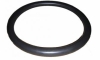

Dichtomatik 75102004 O-Ring, 009 Dash Number, 0.208 in ID x 0.348 in OD, FKM, 75 Shore A Durometer, Import
O-rings are closed circular rings of circular cross-section. They are made through vulcanization from form tools as a complete ring. The sealing function of the O-ring is achieved by the deformation of the cross-section when installed and compressed in its housing. The O-ring can be compressed either radially or axially in its installation housing. In operating conditions the pressure exerted by the media reinforces the sealing function, as under pressure the elastomer material functions as a non-compressible fluid.
Dichtomatik 75102005 O-Ring, 010 Dash Number, 0.239 in ID x 0.379 in OD, FKM, 75 Shore A Durometer, Import
O-rings are closed circular rings of circular cross-section. They are made through vulcanization from form tools as a complete ring. The sealing function of the O-ring is achieved by the deformation of the cross-section when installed and compressed in its housing. The O-ring can be compressed either radially or axially in its installation housing. In operating conditions the pressure exerted by the media reinforces the sealing function, as under pressure the elastomer material functions as a non-compressible fluid.
Dichtomatik 75102006 O-Ring, 011 Dash Number, 0.301 in ID x 0.441 in OD, FKM, 75 Shore A Durometer, Import
O-rings are closed circular rings of circular cross-section. They are made through vulcanization from form tools as a complete ring. The sealing function of the O-ring is achieved by the deformation of the cross-section when installed and compressed in its housing. The O-ring can be compressed either radially or axially in its installation housing. In operating conditions the pressure exerted by the media reinforces the sealing function, as under pressure the elastomer material functions as a non-compressible fluid.
Dichtomatik 75102007 O-Ring, 012 Dash Number, 0.364 in ID x 0.504 in OD, FKM, 75 Shore A Durometer, Import
O-rings are closed circular rings of circular cross-section. They are made through vulcanization from form tools as a complete ring. The sealing function of the O-ring is achieved by the deformation of the cross-section when installed and compressed in its housing. The O-ring can be compressed either radially or axially in its installation housing. In operating conditions the pressure exerted by the media reinforces the sealing function, as under pressure the elastomer material functions as a non-compressible fluid.
Dichtomatik 75102008 O-Ring, 013 Dash Number, 0.426 in ID x 0.566 in OD, FKM, 75 Shore A Durometer, Import
O-rings are closed circular rings of circular cross-section. They are made through vulcanization from form tools as a complete ring. The sealing function of the O-ring is achieved by the deformation of the cross-section when installed and compressed in its housing. The O-ring can be compressed either radially or axially in its installation housing. In operating conditions the pressure exerted by the media reinforces the sealing function, as under pressure the elastomer material functions as a non-compressible fluid.
Dichtomatik 75102009 O-Ring, 014 Dash Number, 0.489 in ID x 0.629 in OD, FKM, 75 Shore A Durometer, Import
O-rings are closed circular rings of circular cross-section. They are made through vulcanization from form tools as a complete ring. The sealing function of the O-ring is achieved by the deformation of the cross-section when installed and compressed in its housing. The O-ring can be compressed either radially or axially in its installation housing. In operating conditions the pressure exerted by the media reinforces the sealing function, as under pressure the elastomer material functions as a non-compressible fluid.
Dichtomatik 75102015 O-Ring, 020 Dash Number, 0.864 in ID x 1.004 in OD, FKM, 75 Shore A Durometer, Import
O-rings are closed circular rings of circular cross-section. They are made through vulcanization from form tools as a complete ring. The sealing function of the O-ring is achieved by the deformation of the cross-section when installed and compressed in its housing. The O-ring can be compressed either radially or axially in its installation housing. In operating conditions the pressure exerted by the media reinforces the sealing function, as under pressure the elastomer material functions as a non-compressible fluid.
Dichtomatik 75102017 O-Ring, 022 Dash Number, 0.989 in ID x 1.129 in OD, FKM, 75 Shore A Durometer, Import
O-rings are closed circular rings of circular cross-section. They are made through vulcanization from form tools as a complete ring. The sealing function of the O-ring is achieved by the deformation of the cross-section when installed and compressed in its housing. The O-ring can be compressed either radially or axially in its installation housing. In operating conditions the pressure exerted by the media reinforces the sealing function, as under pressure the elastomer material functions as a non-compressible fluid.
Dichtomatik 75102020 O-Ring, 025 Dash Number, 1.176 in ID x 1.316 in OD, FKM, 75 Shore A Durometer, Import
O-rings are closed circular rings of circular cross-section. They are made through vulcanization from form tools as a complete ring. The sealing function of the O-ring is achieved by the deformation of the cross-section when installed and compressed in its housing. The O-ring can be compressed either radially or axially in its installation housing. In operating conditions the pressure exerted by the media reinforces the sealing function, as under pressure the elastomer material functions as a non-compressible fluid.
Dichtomatik 75102028 O-Ring, 033 Dash Number, 1.989 in ID x 2.129 in OD, FKM, 75 Shore A Durometer, Import
O-rings are closed circular rings of circular cross-section. They are made through vulcanization from form tools as a complete ring. The sealing function of the O-ring is achieved by the deformation of the cross-section when installed and compressed in its housing. The O-ring can be compressed either radially or axially in its installation housing. In operating conditions the pressure exerted by the media reinforces the sealing function, as under pressure the elastomer material functions as a non-compressible fluid.
Dichtomatik 75102029 O-Ring, 034 Dash Number, 2.114 in ID x 2.254 in OD, FKM, 75 Shore A Durometer, Import
O-rings are closed circular rings of circular cross-section. They are made through vulcanization from form tools as a complete ring. The sealing function of the O-ring is achieved by the deformation of the cross-section when installed and compressed in its housing. The O-ring can be compressed either radially or axially in its installation housing. In operating conditions the pressure exerted by the media reinforces the sealing function, as under pressure the elastomer material functions as a non-compressible fluid.
Dichtomatik 75102054 O-Ring, 110 Dash Number, 0.362 in ID x 0.568 in OD, FKM, 75 Shore A Durometer, Import
O-rings are closed circular rings of circular cross-section. They are made through vulcanization from form tools as a complete ring. The sealing function of the O-ring is achieved by the deformation of the cross-section when installed and compressed in its housing. The O-ring can be compressed either radially or axially in its installation housing. In operating conditions the pressure exerted by the media reinforces the sealing function, as under pressure the elastomer material functions as a non-compressible fluid.
Dichtomatik 75102082 O-Ring, 138 Dash Number, 2.112 in ID x 2.318 in OD, FKM, 75 Shore A Durometer, Import, Custom 138-VITON
O-rings are closed circular rings of circular cross-section. They are made through vulcanization from form tools as a complete ring. The sealing function of the O-ring is achieved by the deformation of the cross-section when installed and compressed in its housing. The O-ring can be compressed either radially or axially in its installation housing. In operating conditions the pressure exerted by the media reinforces the sealing function, as under pressure the elastomer material functions as a non-compressible fluid.
Dichtomatik 75102086 O-Ring, 142 Dash Number, 2.362 in ID x 2.568 in OD, FKM, 75 Shore A Durometer, Import, Custom 142-VITON
O-rings are closed circular rings of circular cross-section. They are made through vulcanization from form tools as a complete ring. The sealing function of the O-ring is achieved by the deformation of the cross-section when installed and compressed in its housing. The O-ring can be compressed either radially or axially in its installation housing. In operating conditions the pressure exerted by the media reinforces the sealing function, as under pressure the elastomer material functions as a non-compressible fluid.
Dichtomatik 75102130 O-Ring, 208 Dash Number, 0.609 in ID x 0.887 in OD, FKM, 75 Shore A Durometer, Import, Custom 208-VITON
O-rings are closed circular rings of circular cross-section. They are made through vulcanization from form tools as a complete ring. The sealing function of the O-ring is achieved by the deformation of the cross-section when installed and compressed in its housing. The O-ring can be compressed either radially or axially in its installation housing. In operating conditions the pressure exerted by the media reinforces the sealing function, as under pressure the elastomer material functions as a non-compressible fluid.
Dichtomatik 75102136 O-Ring, 214 Dash Number, 0.984 in ID x 1.262 in OD, FKM, 75 Shore A Durometer, Import, Custom 214-VITON
O-rings are closed circular rings of circular cross-section. They are made through vulcanization from form tools as a complete ring. The sealing function of the O-ring is achieved by the deformation of the cross-section when installed and compressed in its housing. The O-ring can be compressed either radially or axially in its installation housing. In operating conditions the pressure exerted by the media reinforces the sealing function, as under pressure the elastomer material functions as a non-compressible fluid.
Dichtomatik 75102139 O-Ring, 217 Dash Number, 1.171 in ID x 1.449 in OD, FKM, 75 Shore A Durometer, Import, Custom 217-VITON
O-rings are closed circular rings of circular cross-section. They are made through vulcanization from form tools as a complete ring. The sealing function of the O-ring is achieved by the deformation of the cross-section when installed and compressed in its housing. The O-ring can be compressed either radially or axially in its installation housing. In operating conditions the pressure exerted by the media reinforces the sealing function, as under pressure the elastomer material functions as a non-compressible fluid.
Dichtomatik 75102141 O-Ring, 219 Dash Number, 1.296 in ID x 1.574 in OD, FKM, 75 Shore A Durometer, Import, Custom 219-VITON
O-rings are closed circular rings of circular cross-section. They are made through vulcanization from form tools as a complete ring. The sealing function of the O-ring is achieved by the deformation of the cross-section when installed and compressed in its housing. The O-ring can be compressed either radially or axially in its installation housing. In operating conditions the pressure exerted by the media reinforces the sealing function, as under pressure the elastomer material functions as a non-compressible fluid.
Recently Viewed
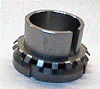
SNW-28 X 4-15/16 WESCO 4-15/16" SPHERICAL BEARING ADAPTER
Adapter Sleeve - 4.9375 in Bore Dia., 101.12 mm Overall Length, 5.497-12 Thread Size, Steel Material

#12X1-1/4" STAINLESS STEEL HEX TEK-3 SCREWS-NBS6930120125B >
1-1/4" OZ PIPE JOINT STICK. PIPE THREAD COMPOUND IN STICK FORM. LUBRICATES, SEALS AND PREVENTS RUST AND CORROSION.-JWH408071 >
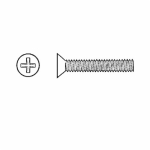
BBI 771468 Fully Threaded Machine Screw, #10-32, 3/4 in OAL, A2 18-8 Stainless Steel, Flat Head, Zinc Blue, Phillips® Drive
BBI 771468 Fully Threaded Machine Screw, #10-32, 3/4 in OAL, A2 18-8 Stainless Steel, Flat Head, Zinc Blue, Phillips® Drive

Browning® mounted ball bearings feature multiple housing styles, materials and configurations, an extended inner race insert bearing with ball riding nylon retainer. The insert features a rivet to prevent outer ring rotation and is available with setscrew, eccentric or BOA concentric locking collar. The contact seal with black oxide treated flinger provides a good balance between contaminant resistance, grease loss and friction.
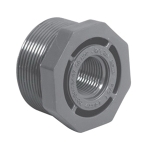
NIBCO® 839-211 Flush, 1-1/2 x 1 in nominal, MNPT x FNPT end style, SCH 80/XH, PVC, Domestic
Fitting Type: Threaded Reducing Bushing Material: Dark gray Schedule 80 polyvinyl chloride (PVC)Size Connections: 1-1/2" Male National Pipe Thread (MNPT / MPT) x 1" Female National Pipe Thread (FNPT / FPT) Pressure Class: Schedule 80 (thick-walled for higher pressure handling compared to standard Schedule 40) Maximum Temperature: 140°F (60°C)

