

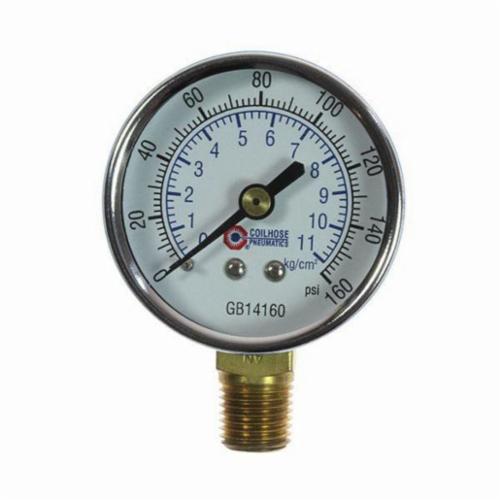
Coilhose® GB14160 Analog Dry Round Pressure Gauge, 0 to 160 psi Pressure, 1/4 in MNPT Connection, 2 in Dia Dial, +/- 3-2-3 % Accuracy

Pressure gauges are an invaluable tool to air system performance. Coilhose Pneumatics offers a wide variety of sizes to meet many applications. All gauges are dry type with either polycarbonate or metal cases and polycarbonate or glass lenses.
-
BrandCoilhose®
-
UPC029292302562
-
Manufacturer Part NumberGB14160
-
CountryUSA
-
Pressure Range0 to 160 psi
-
TypeAnalog Dry Round
-
Connection Size1/4 in MNPT
-
Mounting TypeBottom
-
Accuracy+/- 3-2-3 %
-
Dial Diameter2 in
- Chrome plated case and glass lens
-
UNSPSC41112412
-
Package Description1/PK
-
Catalog
Recently Viewed
Coilhose® GB14160 Analog Dry Round Pressure Gauge, 0 to 160 psi Pressure, 1/4 in MNPT Connection, 2 in Dia Dial, +/- 3-2-3 % Accuracy
Pressure gauges are an invaluable tool to air system performance. Coilhose Pneumatics offers a wide variety of sizes to meet many applications. All gauges are dry type with either polycarbonate or metal cases and polycarbonate or glass lenses.

2-3/16" -ID LOW PILLOW BLOCK UNIT-FYHEBSL21135 >

1-3/16" -ID LOW PILLOW BLOCK UNIT-FYHEBSL20619 >
5/8" X 3-1/2" M/HD OVAL DIE SPRING-LANSMHO625350 >

BANDED V-BELT-JAS12RB100>
SMALL FUZZY DUCK PVC-DIP GLOVES (PR)-BST962S>

